
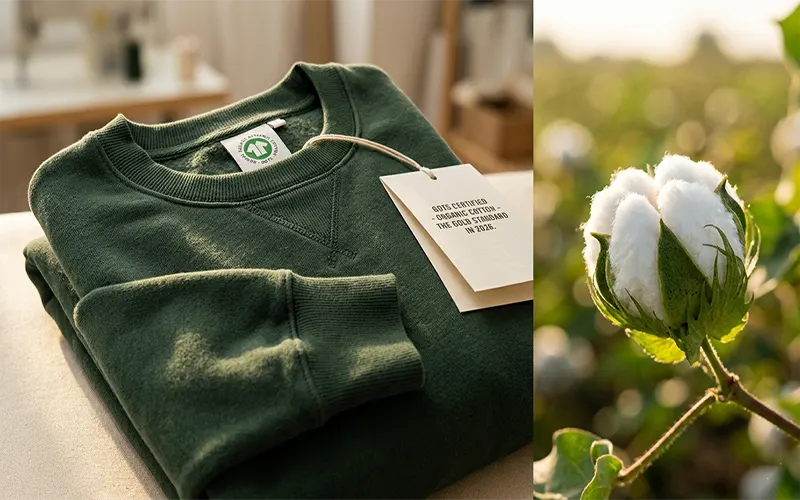
The era of the “disposable” sweatshirt is coming to a definitive end. As we navigate 2026, the global fashion consciousness has shifted away from fleeting trends toward a philosophy of investment dressing. Central to this movement is the heavyweight organic cotton sweatshirt—a garment that marries the architectural structure of luxury fashion with a radical commitment to planetary health.
However, not all organic cotton is created equal. To truly claim the title of “sustainable,” a garment must now meet the rigorous benchmarks of the Global Organic Textile Standard (GOTS) Version 8.0, released in March 2026. This guide explores why the combination of heavyweight fabric and GOTS 8.0 certification is the only logical choice for the modern, conscious wardrobe.
1. The Power of the Heavyweight: Defining 400 GSM
In the world of textiles, quality is often measured in GSM (Grams per Square Meter). Most mass-market sweatshirts hover between 200 and 250 GSM—weights that often lead to sagging necklines and pilling after just one season.
A true “heavyweight” sweatshirt starts at 330 GSM, with the gold standard for luxury basics reaching 400 GSM or higher. There are three primary reasons why weight matters:
- Structural Integrity: Heavyweight cotton (often in a 3-end fleece or dense French Terry weave) holds its shape. It drapes off the shoulders with a crisp, intentional silhouette that doesn’t “cling” like thinner fabrics.
- Thermal Regulation: The density of a 400 GSM fabric provides natural insulation. It creates a microclimate against the skin, offering warmth without the need for synthetic, plastic-based linings.
- The Durability ROI: A heavyweight garment is inherently more resistant to mechanical stress. It survives more wash cycles, resists tearing, and maintains its color depth longer than its lighter counterparts.
2. GOTS 8.0: The 2026 Sustainability Benchmark
As of March 2026, the Global Organic Textile Standard has leveled up. GOTS 8.0 isn’t just a label; it is a comprehensive “seed-to-shelf” audit that ensures every hand that touched the garment was treated fairly and every drop of water used was managed responsibly.
What’s New in Version 8.0?
- Mandatory Due Diligence: For the first time, GOTS 8.0 makes the OECD Due Diligence Guidance mandatory. This means brands must actively identify, prevent, and mitigate human rights and environmental risks across their entire supply chain—not just in the final factory.
- Deforestation-Free Verification: In alignment with new global regulations, 2026 GOTS-certified cotton must be verified as deforestation-free. This ensures that your sweatshirt didn’t come at the cost of primary forests.
- Stricter Chemical Controls: Version 8.0 introduces even tighter limits on PFAS (the “forever chemicals”) and endocrine disruptors, ensuring that what sits against your skin is as pure as the soil the cotton grew in.
3. The Environmental Case for Organic Heavyweights
Choosing organic cotton is a vote for biodiversity. Conventional cotton is often called the “world’s dirtiest crop,” accounting for nearly 4% of global insecticide use despite occupying only 2.5% of the world’s arable land.
GOTS-certified organic cotton eliminates these synthetic toxins, relying instead on:
- Biological Pest Management: Using beneficial insects and neem-based treatments.
- Rain-Fed Irrigation: Organic soil, rich in organic matter, holds water significantly better than chemical-depleted soil. This can reduce “blue water” consumption by up to 91% compared to conventional farming.
- Carbon Sequestration: Healthy, organic soil acts as a carbon sink, pulling CO2 out of the atmosphere and helping to mitigate the climate crisis—a critical factor in the 2026 “Net Zero” fashion goals.
4. How to Spot the Real Deal
With “greenwashing” reaching an all-time high in 2026, consumers must look beyond the word “organic” on a tag. To verify a heavyweight sweatshirt’s pedigree, follow these steps:
- Look for the Logo: A genuine GOTS product must display the GOTS logo and the License Number of the certified entity.
- Check the GSM: If a brand claims “heavyweight” but doesn’t list the GSM, ask. A luxury-tier sweatshirt should always be transparent about its fabric weight (look for 350–450 GSM).
- Verify the Scope: Ensure the entire garment is certified. GOTS 8.0 has clarified rules for “mixed” products, making it easier for consumers to see exactly which parts of a garment meet the standard.
5. Longevity and Care: Protecting Your Investment
A 400 GSM GOTS sweatshirt is designed to last a decade, but it requires proper care. Because organic cotton is free from harsh chemical stabilizers, it is more sensitive to high heat.
- The Cold Wash Rule: Always wash in cold water (30°C or below). This prevents the dense fibers from shrinking and preserves the natural oils of the cotton.
- Avoid the Dryer: High heat is the enemy of heavyweight fleece. Air-drying your sweatshirt flat prevents “hanger-stretch” and keeps the interior fleece soft and plush.
- Spot Clean: Because the fabric is so dense, it often doesn’t need a full wash after every wear. Spot cleaning extends the garment’s life and saves gallons of water.
The Future is Heavy
In 2026, luxury is no longer defined by a logo, but by the integrity of the construction. A heavyweight organic cotton sweatshirt with GOTS 8.0 certification is more than a piece of clothing; it is a manifesto for a better industry. By choosing quality over quantity and transparency over convenience, you aren’t just buying a sweatshirt—you are supporting a circular, ethical, and resilient future for fashion.