The university textbook industry is a $14 billion behemoth that has long left students with “sticker shock” at the start of every semester. While campus bookstores offer convenience, their buy-back rates are notoriously low, often offering students pennies on the dollar for books that retail for hundreds.
In April 2026, this massive price gap has created a golden opportunity for local student entrepreneurs. By launching a lean, second-hand textbook reselling business, you can provide a vital service to your peers—buying high, selling low, and still pocketing a significant margin. Here is your playbook for launching a campus-based textbook empire with almost zero overhead.
1. The Arbitrage Model: Master the “Buy-Back Gap”
The secret to a successful reselling business is simple: Arbitrage. This is the practice of taking advantage of a price difference between two markets.
The Math of the Gap
A typical campus bookstore might buy a used Biology textbook for $30 and resell it for $150. As an independent reseller, you can disrupt this by offering the student $55 (nearly double the bookstore’s offer) and reselling it for $110. You make a $55 profit, the seller gets more cash, and the buyer saves $40. It is a rare “triple-win” scenario.
Off-Season Sourcing
Timing is everything. The most profitable resellers operate on a seasonal cycle:
- The “Finals Week” Goldmine: This is when supply is at its highest. Students are moving out, desperate for cash, and looking to lighten their luggage. This is your time to buy.
- The “Syllabus Week” Surge: This is the first week of classes when demand peaks. This is your time to sell. By holding inventory for just three months over the summer or winter break, you can maximize your ROI.
2. Tech-Enabled Logistics: Running a Lean 2026 Startup
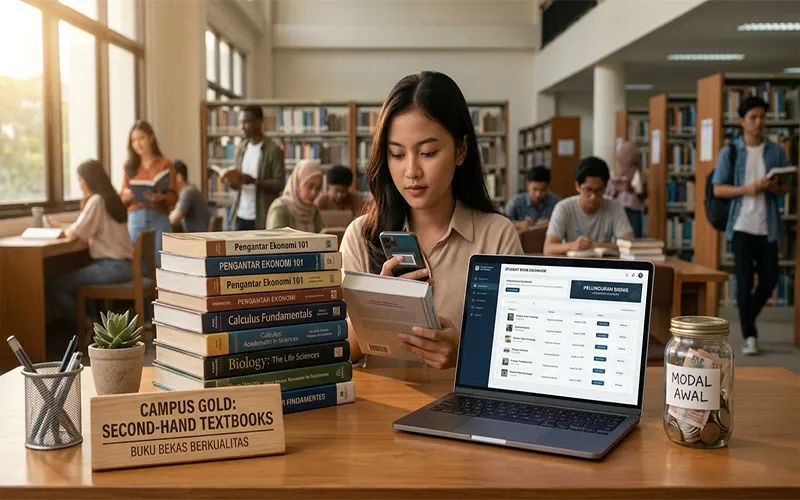
In 2026, you don’t need a storefront or a warehouse. Your business lives on your smartphone and in the high-traffic zones of your campus.
AI-Powered Valuation
Before you hand over a single dollar, you must know the book’s real-time market value. Use AI-powered barcode scanning apps that aggregate data from eBay, Amazon, Chegg, and BookFinder. These tools allow you to see the “Floor Price” (the lowest it’s currently selling for online) so you never overpay for inventory that is about to be replaced by a new edition.
Hyper-Local Marketplaces
Avoid the trap of shipping costs and seller fees on major platforms. Build your own “walled garden” on campus:
- Discord & WhatsApp: Create dedicated “Textbook Exchange” servers for specific majors (e.g., “State Uni Engineering Books”).
- Notion Shops: Use a simple, public Notion page as your digital storefront where students can see your current inventory, condition photos, and prices.
- Safe-Exchange Zones: Always conduct transactions in high-visibility areas like the Student Union or the “Safe Trade Zones” often provided by campus police.
3. Inventory Selection: STEM vs. Electives
Not all books are created equal. To keep your business low-cost and high-profit, you must be selective about what you carry in your “dorm-room warehouse.”
- The STEM & Medical “Blue Chips”: Textbooks for Organic Chemistry, Physics, and Nursing have high price retention. These books are expensive, bulky, and rarely change drastically between editions, making them safe investments.
- The Elective Trap: Avoid books for “Intro to Film” or elective English classes. These are often inexpensive paperbacks with low resale value that take up too much space.
- The “Previous Edition” Strategy: Many professors allow students to use the 9th edition even if the 10th is out. If you can verify this through the departmental syllabus, you can buy 9th-edition books for nearly nothing and sell them as a “budget-friendly” alternative to students.
4. The “Pop-Up” Operations Strategy
To keep overhead at zero, your operations must be mobile and decentralized.
Zero-Warehouse Management
Your “warehouse” can be a set of heavy-duty plastic bins under your bed or even the trunk of your car.
- Drop Zones: Use the campus library’s locker system or a partner cafe as a “drop zone” where students can leave books for you to inspect in exchange for a digital payment (Venmo/CashApp).
- The 5-Point Quality Inspection:
- Water Damage: Check for “wavy” pages (a dealbreaker for most buyers).
- Highlighting: Moderate highlighting is okay; “blacking out” text is not.
- Missing Pages: Flip through the back index and front matter.
- Access Codes: If the book requires a digital code, inform the buyer if yours is used. In 2026, students can often buy “standalone” codes, so a used-code book is still sellable if priced correctly.
- Binding: Ensure the spine isn’t cracked or pulling away.
5. Scaling and Building Trust
Trust is the currency of a campus business. If you sell a student a book with missing pages, your reputation—and your business—will vanish by mid-semester.
The “Syllabus Week” Marketing Blitz
During the first week of classes, be visible. Use QR-code stickers on campus bulletin boards that lead directly to your Notion inventory. Offer a “7-Day Return Policy” if a student drops a class; this eliminates the risk for the buyer and makes them much more likely to choose you over an anonymous seller on a national site.
Legalities and Micro-Entrepreneurship
Keep a simple spreadsheet of your “Buy” and “Sell” prices. While this starts as a side hustle, tracking your profits is essential for scaling. If you exceed local tax thresholds, having these records will make you a legitimate “Student Founder” rather than just a reseller.
Turning Pages into Profit
Launching a second-hand textbook business is the ultimate “learn-while-you-earn” venture. It teaches you the fundamentals of supply chain, dynamic pricing, and customer service—all while helping your fellow students fight back against the high cost of education.
By focusing on high-value STEM books, leveraging local messaging apps for logistics, and maintaining a rigorous quality standard, you can turn a few boxes of books into a thriving campus network.