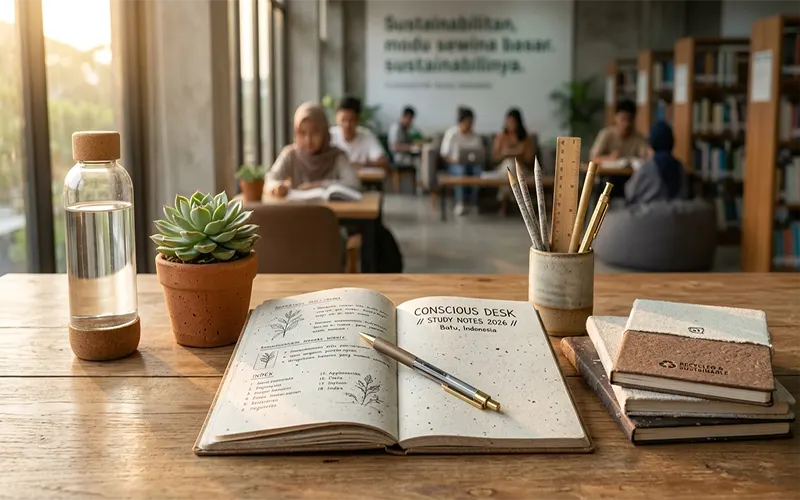
In the landscape of 2026, the digital-everything era has hit a fascinating plateau. While tablets and styluses remain ubiquitous, a profound “analogue comeback” has taken root among Gen Z and Gen Alpha students. This isn’t just a retro trend; it’s a tactile rebellion. However, this new generation of learners isn’t interested in the wasteful stationery habits of the past. They are building The Conscious Desk—a workspace where high-performance tools meet rigorous, verifiable environmental standards.
If you’re looking to upgrade your study setup, this guide breaks down the tech, the materials, and the certifications that define the gold standard of eco-stationery today.
1. The New Standard for Paper: Beyond the Tree
In 2026, “recycled” is no longer a monolith. To be a conscious consumer, you need to look at the source of the fiber.
PCW vs. Pre-Consumer: The Real Winner
When you browse for notebooks, you’ll see two main types of recycled content: Post-Consumer Waste (PCW) and Pre-Consumer Waste.
- Pre-Consumer Waste is essentially factory scraps—paper that never reached a customer. While using it is better than throwing it away, it doesn’t drive the recycling industry forward.
- PCW (Post-Consumer Waste) is the true hero. It is made from the paper you put in your recycling bin—old mail, magazines, and office documents. By choosing 100% PCW notebooks, you are actively participating in a closed-loop system, ensuring that discarded paper has a second life as your chemistry notes.
The Rise of Alternative Fibers
While trees are the traditional source for paper, 2026 has seen the explosion of “tree-free” alternatives that often boast a lower carbon footprint and unique tactile qualities:
- Hemp & Bamboo: These are the “super-crops” of the stationery world. They grow exponentially faster than trees and require significantly less water. Bamboo paper is known for its incredible smoothness, while hemp offers a rugged durability that makes it perfect for covers.
- Agricultural Waste (Straw/Husk): Innovative brands are now upcycling the leftovers from food production. Straw, wheat husks, and even sugarcane bagasse (the pulp left after juice extraction) are being turned into high-quality sheets.
- Stone Paper: This is a game-changer for those who need a durable, waterproof surface. Made from calcium carbonate (waste from quarries) bonded with a small amount of non-toxic resin, it uses zero water, trees, or bleach in its production.
The Badge of Honor: Certifications
Don’t take a brand’s word for it. Look for the “big two” labels:
- FSC Recycled: This confirms the paper is made from 100% recycled content. The Forest Stewardship Council is the global watchdog for responsible forestry.
- Blue Angel: The world’s oldest environmental label. If a notebook carries this, it means the paper was produced without harmful chemicals and meets strict standards for energy and water use.
2. Innovations in Pens and Writing Tools
The “disposable” pen is a relic of the 20th century. In 2026, your pen is a lifetime companion, not a plastic stick destined for a landfill.
Infinite Refill Systems and Modular Design
The most advanced pens on the market today are Modular. We’ve moved far beyond simply replacing an ink cartridge. In a modular system, every single component is replaceable: the nib, the internal spring, the clip, and the barrel. If you drop your pen and dent the casing, you don’t toss the whole unit; you simply order a replacement part. This “Right to Repair” philosophy ensures that the primary body of your pen can stay on your desk for decades.
The Fountain Pen Renaissance
Fountain pens have staged a massive comeback among students, and for a purely practical reason: they are the ultimate zero-waste writing tool. By using a converter (a refillable internal tank) and bottled ink, you eliminate the need for plastic cartridges entirely.
Furthermore, the “Eco-Ink” of 2026 is often vegetable-based or even algae-based. These inks are non-toxic and biodegradable, unlike the petroleum-based inks found in traditional ballpoints, making the paper they sit on easier to recycle.
3. Circular Design & End-of-Life
A notebook’s sustainability is measured by how it starts and how it ends.
Lay-Flat Binding vs. Plastic Glue
Most cheap notebooks use “Perfect Binding,” which relies on heavy plastic-based glues to hold the pages together. Not only do these notebooks refuse to stay open, but the glue is a major contaminant in the recycling process.
The 2026 standard is Smyth Sewn (Thread) Binding. By using organic cotton thread to stitch “signatures” of paper together, brands create a notebook that lays perfectly flat. When you’ve filled the last page, the cotton thread is biodegradable, and the absence of glue makes the paper much easier for recycling facilities to process.
The “Plantable” Notebook
One of the most poetic trends in eco-stationery is Seed Paper. Some high-end sustainable notebooks feature covers embedded with wildflower or herb seeds. Once you’ve finished the notebook and archived your digital scans, you can tear off the cover, bury it in a pot of soil, and watch it turn into a mini-garden. It is the ultimate expression of “End-of-Life” utility.
4. The “Calm Aesthetic” Trend (2026)
Sustainability in 2026 has a specific look: it’s minimal, intentional, and soothing. The “Calm Aesthetic” has replaced the neon plastics of the 2010s.
- Earthy Tones: Expect to see palettes of Sage, Terracotta, Oatmeal, and Slate. These colors are often achieved through mineral pigments or natural dyes, reducing the chemical load of the manufacturing process.
- Minimalist Layouts: Notebooks are moving away from heavy, dark lines. Faint “dot grids” or light grey ruling are the standard. Why? Because using less ink per page makes the de-inking process during recycling much more efficient.
5. Technical Sidebar: Understanding the “Life Cycle”
Why does all of this matter? The math of recycling is startling. When you opt for a recycled paper notebook over one made from virgin wood pulp, the environmental ROI is massive:
- Energy Savings: Producing recycled paper uses roughly 40% less energy than processing raw timber. This is because the “heavy lifting” of breaking down wood fibers has already been done once.
- Water Conservation: Processing virgin pulp is a water-intensive nightmare. Recycled paper manufacturing uses 50% less water, preserving local ecosystems and reducing the strain on utility grids.
- Chemical Reduction: Recycled paper requires far less bleaching and harsh chemicals to reach a usable state, preventing toxic runoff into waterways.
Build a Desk That Reflects Your Future
In 2026, your desk is a statement of intent. Choosing a 450 GSM boxy fit sweatshirt is a style choice; choosing FSC-certified, PCW stationery is a legacy choice. By investing in tools that are modular, refillable, and circularly designed, you aren’t just organizing your thoughts—you are ensuring that the pursuit of knowledge doesn’t come at the expense of the world you’re preparing to lead.