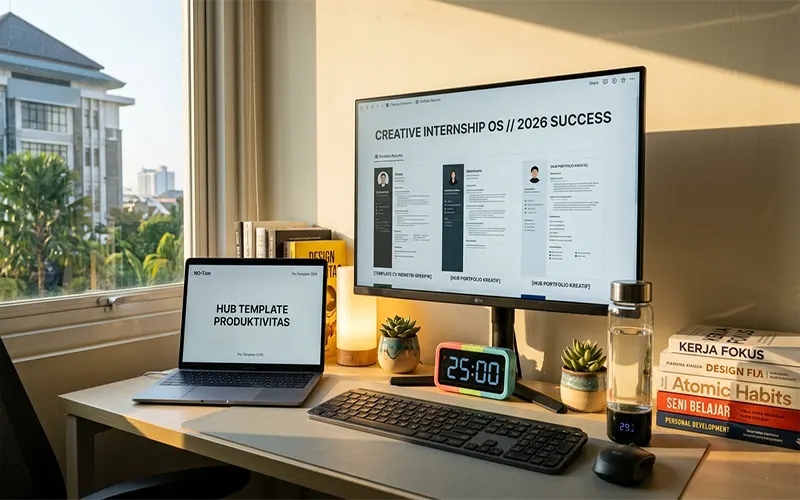
The traditional black-and-white, text-heavy resume is no longer the standard for the creative industries. In 2026, the resume has evolved into a “brand document”—the first piece of your portfolio that a recruiter ever sees. However, as internships become increasingly competitive, a new challenge has emerged: the AI-First, Human-Second Paradox.
Your resume must be visually striking enough to catch the eye of a Creative Director in under six seconds, yet technically structured enough to pass through an Applicant Tracking System (ATS) that uses AI to filter for keywords. To land a top-tier internship this year, you need a template that speaks the specific language of your niche.
1. The Dual-Format Challenge: Designing for Two Audiences
Before choosing a template, you must understand the “scannability” requirements of 2026.
The AI Filter (ATS)
Most large firms use AI to parse your PDF. If you use complex graphics, text inside images, or non-standard symbols, the AI will fail to “read” your contact info or experience.
- The Rule: Use standard section headers (e.g., “Experience,” not “Where I’ve Been”) and ensure your body text is a standard, selectable font.
The Human Director
Once you pass the AI, a human needs to see your “design eye.” This is where typography, white space, and hierarchy come into play. In 2026, a “Creative CV” is expected to be mobile-optimized and accessible, featuring high color contrast and clean layouts.
2. Archetype 1: The Minimalist Architect & Industrial Designer
For those in Architecture or Product Design, the resume should mirror the work: structured, functional, and precise. Recruiters in these fields value the ability to organize complex information.
- The Layout: Use a Strict Grid System. Align your text to a clear vertical axis to demonstrate an understanding of spatial organization.
- Typography: Opt for a high-quality Sans-serif (like Inter or Neue Haas Grotesk).
- Color Palette: Monochromatic. Use black, white, and various shades of grey to create a “blueprint” feel.
- The “Technical Stack” Sidebar: Place your software proficiencies (Revit, Rhino, Grasshopper, Adobe Suite) in a clean, vertical list on the left or right margin. Do not use “percentage bars” to show skill levels; instead, categorize them by “Expert,” “Intermediate,” or “Familiar.”
3. Archetype 2: The High-Impact Marketer & Content Creator
Digital Marketing and Content Creation internships require a resume that feels energetic and data-driven. You are selling your ability to capture attention.
- The Layout: Use Bold Section Breaks and asymmetrical blocks to create a dynamic flow.
- Typography: Mix a bold, expressive Sans-serif for headers with a highly readable Sans-serif for body text.
- Color Palette: Use “Executive Neutrals” with one bold accent color—Sage, Terracotta, or Deep Cobalt are the dominant trends of 2026.
- The “Social Proof” Section: Marketing recruiters want to see results. Include a “Key Metrics” section where you highlight growth (e.g., “Grew TikTok following by 40% in 3 months”).
- QR Integration: Place a polished QR code in the header that links directly to a mobile-friendly campaign deck or video reel.
4. Archetype 3: The Narrative-Driven Writer & Strategist
For copywriters, journalists, and brand strategists, the resume is a writing sample. Your goal is to prove that you can communicate a “brand hook” with clarity and elegance.
- The Layout: Focus on Readability and Margins. Give the text room to breathe. Use wide margins (at least 1 inch) to avoid a “cramped” feeling.
- Typography: Use a modern Serif font (like Chronicle or Playfair Display) for your name and headers. Serifs communicate authority and a classic editorial sensibility.
- The “Brand Hook”: Start with a 3-line “Personal Mission Statement” instead of a traditional objective. This should summarize your unique perspective as a storyteller.
- The Experience Section: Focus on “Impact Verbs” rather than task lists. Instead of “wrote blog posts,” use “crafted narrative-driven content that increased reader dwell time by 25%.”
5. Technical Sidebar: The “Invisible” Resume Elements
In 2026, what you don’t see is as important as what you do.
SEO Keywords for Creatives
To pass the AI filters, you must weave industry-specific “Skill-Stack” terms naturally into your descriptions.
- UI/UX: “Iterative Design,” “Wireframing,” “Figma Components,” “Heuristic Evaluation.”
- Architecture: “BIM Workflow,” “Sustainability Modeling,” “LEED Standards,” “Historic Stewardship.”
- Marketing: “Consumer Insights,” “Generative AI Prompting,” “Multichannel Strategy,” “Conversion Rate Optimization.”
Accessibility (WCAG)
A truly professional creative resume is accessible. Ensure your font size is at least 10pt and that your text color has high contrast against the background. Using “Color-blind friendly” palettes shows a recruiter that you design with empathy—a massive plus for modern internships.
From Applicant to Brand
Landing a creative internship in 2026 is about proving you can balance aesthetic beauty with functional utility. Your resume shouldn’t just list where you’ve been; it should show where your taste is going. By choosing an industry-specific archetype and optimizing it for both AI and human eyes, you transform from a name on a screen into a compelling professional brand.