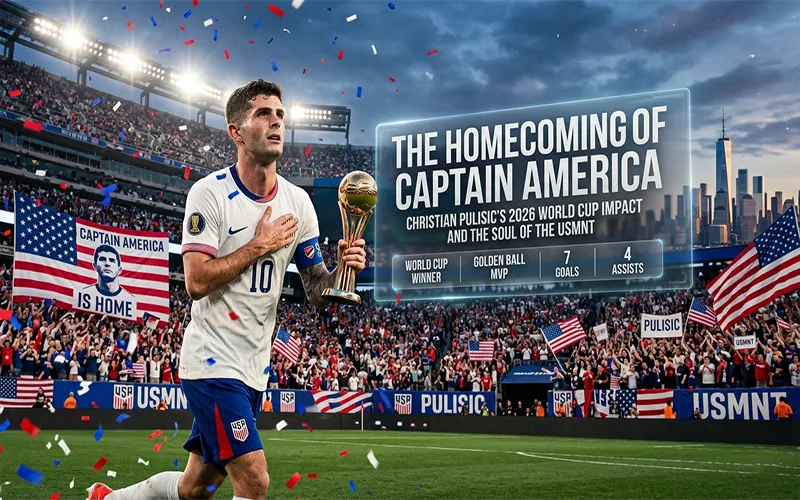
It is April 2026, and a palpable energy is beginning to electrify the United States. In less than two months, the single largest sporting event on the planet, the FIFA World Cup, returns to North American soil. While iconic venues from Los Angeles to New York prepare to host the globe’s elite, for the American sporting public, the tournament is defined by the image of one man on a billboard that stretches across times square. That man is Christian Pulisic.
Now 27 years old, playing the most refined football of his life at AC Milan, and entering his athletic prime, Pulisic is no longer the “wunderkid” carrying the hopes of a nation on fragile shoulders. He is the standard-bearer. The upcoming 2026 World Cup is not merely another tournament for “Captain America”; it is the final exam of a career dedicated to bridging the gap between American “soccer” and global “football.”
1. The Road to 2026: The Hershey Metamorphosis
Pulisic’s journey to this moment is paved with the resilience that has come to define this USMNT generation. He is the sole survivor of the “Couva Nightmare” of 2017, the teenager who wept openly on the pitch in Trinidad after the U.S. failed to qualify for the 2018 tournament. That trauma forged him.
By the 2022 World Cup in Qatar, he was the leader of the “Golden Generation,” delivering the defining moment of that cycle: throwing his body into a collision with the Iranian goalkeeper to score the goal that sent the U.S. to the knockout rounds. Since that sacrificial goal, Pulisic has undergone a crucial metamorphosis in Italy. At AC Milan, under the intense scrutiny of the San Siro, he transformed from a “fragile winger” who struggled with injuries in the Premier League into a durable, multi-faceted Serie A star. In 2026, he enters the World Cup having just completed a season of 15 goals and 12 assists in all competitions—elite, sustained production.
2. Tactical Impact on the Pitch: The “Pulisic Gravity”
While his statistical output is elite, Pulisic’s impact on Gregg Berhalter’s 2026 tactical system is deeper than goals and assists. He is the foundational piece of the attack, and his effect on the pitch can be summed up in one word: Gravity.
Operating primarily on the left wing, Pulisic demands constant attention from opposing managers. He draws defenders toward him like a celestial body. This “Pulisic Gravity” is the master key that unlocks the rest of the USMNT’s offensive arsenal. Because teams must double-team him, they are forced to leave gaps elsewhere. This opens space in the center for the technical genius of Gio Reyna, creates one-on-one opportunities on the right for Folarin Balogun, and allows Weston McKennie to make his trademark crashing runs into the box from midfield.
Furthermore, Pulisic has evolved his game beyond simple speed. In 2026, he is a master of the “half-space,” able to drift inside and operate as an attacking midfielder. His set-piece delivery has become a lethal weapon for a USMNT that has historically relied on restarts for crucial goals.
3. The Leadership Burden: The Quiet Icon
Being the face of a home World Cup is a psychological weight that few athletes can truly understand. In a nation where soccer is battling for space on the sports-center highlight reel alongside the NFL and NBA, the pressure on Pulisic to deliver “moments” is immense.
Unlike many modern global superstars, Pulisic is a quiet icon. He is not a vocal “shouter” like his teammate Tyler Adams. He is a “lead-by-example” captain, a leader through work-rate and courage. The team respects him because they know he is the first player to track back and the last player to leave the training pitch. This “quiet resilience” matches the vibe of this 2026 squad—they are hardworking, physically dominant, and unified.
4. 2026 Appearance Projections and Squad Management
The 2026 tournament, with 48 teams, is a seven-game endurance test to reach the final. Managing Pulisic’s minutes will be Berhalter’s most delicate task. The U.S. will likely play its group stage matches on the West Coast (cities like Seattle and Los Angeles).
- The Group Stage Strategy: While Pulisic wants to play every minute, Berhalter must ensure he is fresh for the knockout rounds. In a group stage where goal differential might matter, Pulisic might start every game but be subbed off if the U.S. has a safe lead by the 60th minute.
- The Injury Risk: The heavy travel, intense climate, and high stakes make proper rotation vital. The USMNT’s depth has improved, meaning they can succeed without him for spells, but for the “Legacy Matches” (Round of 16 and beyond), “Captain America” must be at 100%.
The GOAT Debate and Donovan’s Shadow
The definitive question of this 2026 cycle is one of legacy. For over a decade, American soccer fans have debated the GOAT (Greatest of All Time). Is it the clinical finishing of Clint Dempsey, or the tournament heroics of Landon Donovan?
In 2026, Pulisic is poised to end that debate. A quarter-final run—matching the heroic team of 2002—where Pulisic delivers massive, signature goals on home soil, would solidify his GOAT status. But a run beyond the quarter-finals? A run that inspires a new generation and makes soccer the dominant cultural conversation of the American summer? That would make Christian Pulisic more than a GOAT. It would make him an immortal of American sports.
🟢 Christian Pulisic: By the Numbers (Projected: June 2026)
| Metric | Projection | Legacy Note |
| Total USMNT Caps | 92 | Will move into top-10 all-time caps. |
| Total USMNT Goals | 44 | Chasing Dempsey/Donovan’s joint-record of 57. |
| AC Milan 25/26 Season Goals | 15 | Peak professional form entering tournament. |
| 2022 World Cup Goals/Assists | 1g / 2a | The engine of the Qatar knockout run. |
| 2026 World Cup Projection | 3 Goals | Expected to be the team’s leading scorer in N. America. |