
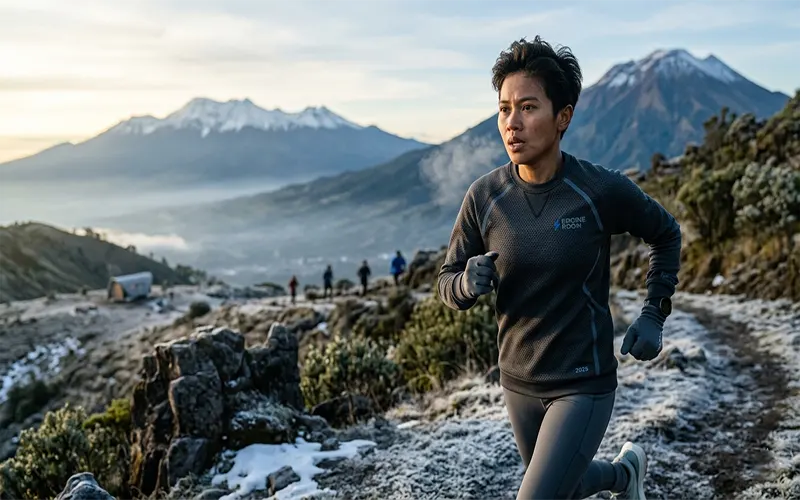
Winter running in 2026 is no longer a battle of attrition against the elements; it is a study in precision engineering. The “Paradox of the Cold”—the high-stakes struggle to maintain core warmth while managing the massive amounts of sweat generated by a high-intensity effort—has finally been solved by a new generation of active insulation.
For the modern runner, the traditional “heavy hoodie” is a liability. It absorbs moisture, saps energy, and leads to the dreaded “post-run chill.” To dominate sub-zero miles, you need a moisture-wicking thermal sweatshirt that functions as an extension of your own thermoregulatory system.
1. The Science of Active Insulation: Hydrophobic vs. Hydrophilic
In 2026, the secret to staying warm is actually the science of staying dry. When you run in sub-freezing temperatures, your body still produces sweat. If that moisture stays trapped against your skin, it conducts heat away from you 25 times faster than air, leading to a rapid drop in core temperature.
Grid Fleece Technology
The gold standard for winter 2026 is Grid Fleece. Instead of a solid wall of fabric, the interior is composed of raised “pockets” of lofted fleece separated by recessed channels.
- The Loft: The raised squares trap air, creating a layer of dead-air insulation.
- The Channels: The recessed areas act as highways for moisture vapor, allowing it to escape before it condenses into liquid sweat.
2. Body-Mapped Engineering: Zonal Thermal Mapping
The human body does not heat up uniformly. Your chest and shoulders are primary heat-loss zones, while your back and underarms are “engine rooms” that generate excessive moisture.
3D-Knit and Zonal Construction
Elite 2026 sweatshirts utilize Zonal Thermal Mapping. This means the garment is constructed from varying fabric weights in a single, often seamless, piece:
- High-Loft Panels: Placed on the chest and upper arms to block wind and retain core heat.
- Laser-Cut Ventilation: Micro-perforations or lighter mesh knits are placed down the spine and under the armpits to dump heat the moment it becomes excessive.
- 3D-Knit Seamless Construction: By eliminating seams in high-friction areas, 2026 gear prevents the painful chafing that often occurs when salt crystals from sweat dry during long-distance efforts.
3. The Material Revolution: Merino-Poly Hybrids & Graphene
We have moved beyond 100% synthetic gear. The “High-Performance Hybrid” is the dominant material of 2026.
- Merino-Synthetic Blends: These hybrids take the natural, “warm-when-wet” properties of Merino wool and reinforce them with the fast-drying durability of recycled polyester. The result is a sweatshirt that doesn’t “stink” after three runs and dries in record time.
- Graphene-Infused Fibers: Graphene is an incredible thermal conductor. When infused into the fibers of a sweatshirt, it pulls heat away from “hot spots” (like your core) and redistributes it to “cold spots” (like your extremities), creating a perfectly balanced micro-climate around your body.
4. Functional Design: Features for the 2026 Runner
The difference between a “good” and “elite” winter sweatshirt is in the small, runner-specific details that allow for uninterrupted performance.
- Watch Windows: Integrated slits at the wrist allow you to check your smartwatch data without pulling up your sleeve and exposing your skin to -10°C air.
- Scuba Hoods & Integrated Buffs: High-performance hoods are now “scuba-style”—tight-fitting to the head so they don’t catch the wind, often featuring a built-in mesh face mask that can be pulled up to protect the lungs from “cold-air burn.”
- Thumb Loops & Hand Coverage: Extended sleeves with thumb loops keep the garment in place and act as a lightweight “first-layer” glove, essential for the first two miles before your circulation fully kicks in.
5. Layering Logic: The 2026 Temperature Guide
To maximize the effectiveness of your thermal sweatshirt, you must pair it correctly. The “10-Degree Rule” remains the runner’s mantra: dress as if it is 10°C (18°F) warmer than the thermometer says.
| Temp Range | Layering Strategy | Recommended GSM |
| 5°C to 0°C | Thermal Sweatshirt + Lightweight Tee | 150–200 GSM |
| 0°C to -10°C | Merino Base + Grid Fleece Sweatshirt | 250–300 GSM |
| Below -10°C | Heavy Base + Thermal Sweatshirt + Wind Shell | 300+ GSM |
6. The 2026 Styling Trend: “Ghost” Reflectivity
In 2026, safety has moved past neon yellow. The trend is Iridescent Reflectivity. By day, your thermal sweatshirt might be a sleek, matte charcoal or deep forest green. However, the fabric is infused with “ghost” glass beads that glow with a brilliant, multi-colored iridescence when hit by car headlights. This ensures you are visible in the low-light conditions of winter without looking like a construction worker during your mid-day miles.
Building Your Winter Armor
Choosing a moisture-wicking thermal sweatshirt in 2026 is about understanding your own “heat signature.” If you are a high-output runner who sweats heavily, prioritize Grid Fleece and Zonal Mapping. If you are a long-distance “slow-burn” runner, lean into Merino-Graphene hybrids for steady, consistent warmth.
By investing in gear that understands the physics of moisture and heat, you aren’t just surviving the winter—you’re mastering it. Your training doesn’t have to stop when the temperature drops; you just need a better engine room.
🧼 Wash & Care Sidebar
To preserve the “wicking” properties of your 2026 gear:
- Never use fabric softener: It coats the fibers in a waxy film that clogs the moisture-wicking channels.
- Cold Wash Only: High heat can damage the Graphene and silver-ion antimicrobial treatments.
- Air Dry: The “FlashDry” tech in modern gear means it will be dry in minutes anyway—keep it away from the dryer to preserve the fit.