For decades, the “tech barrier” was a wall made of syntax, semicolons, and complex algorithms. If you were a history buff, a marketing strategist, or a creative writer, you were often told that “coding wasn’t for you.”
But in April 2026, the landscape has fundamentally shifted. The hottest new programming language isn’t Python or Rust—it’s English.
Prompt engineering has emerged as the ultimate “bridge” skill, allowing individuals with zero technical background to command world-class AI models. In fact, many industry leaders now argue that liberal arts and business majors have a natural advantage in this field; their training in logic, nuance, and human psychology is exactly what’s needed to guide an AI effectively.
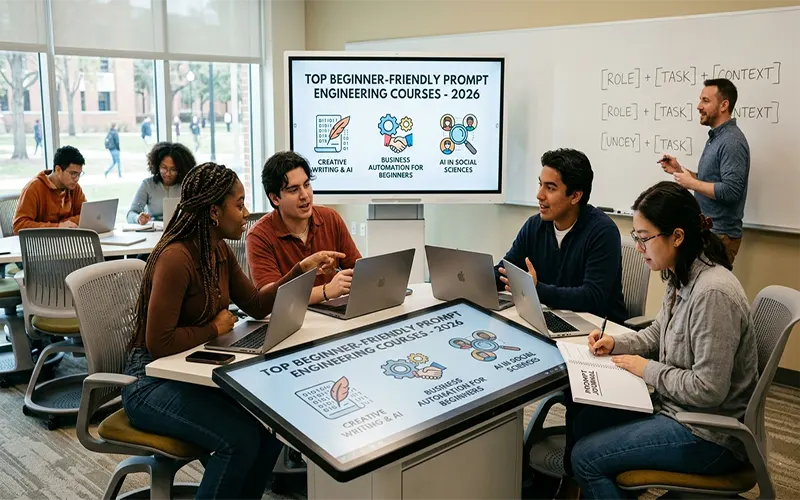
If you’re looking to future-proof your career without a Computer Science degree, here are the best beginner-friendly courses to master prompt engineering in 2026.
1. Google AI Professional Certificate (The All-Rounder)
Google’s 2026 update to its AI certificate is a masterclass in practical application. Designed specifically for workplace tasks, this program skips the “how a transformer works” lecture and goes straight to “how to make AI do your job for you.”
- Best For: Career pivoters and corporate professionals.
- Key Highlight: The “AI for Brainstorming and Planning” module. You’ll learn to use AI as a strategic partner to build 12-month project timelines and marketing funnels from a single paragraph of intent.
- Unique Feature: It introduces “Vibe Coding” for non-techies—a workflow where you describe an app’s “vibe” and functionality to a coding agent that builds the software for you. It’s the ultimate “zero-to-one” experience for someone who has never touched a line of code.
2. Vanderbilt University’s “Prompt Engineering for ChatGPT” (The Logic Builder)
Available on Coursera, this is widely considered the academic gold standard. Taught by Dr. Jules White, it focuses on the “science” of communication through Prompt Patterns.
- Best For: Students who want a deep, structural understanding of LLMs.
- Key Highlight: You will master the “ACHIEVE” Framework—a mental checklist for ensuring your prompts are clear, context-rich, and goal-oriented.
- The “Patterns” Mastery: You’ll learn specific techniques like the Persona Pattern (making the AI act as an expert) and the Flipped Interaction Pattern (where the AI asks you questions to refine the output).
3. DeepLearning.AI: “Generative AI for Everyone” (The Executive Choice)
Taught by AI pioneer Andrew Ng, this course is famous for its “extremely low hype, high utility” approach. It’s one of the shortest yet most impactful certificates you can earn.
- Best For: Business majors and leaders who need to understand AI ROI.
- Key Highlight: Andrew Ng explains Cost Intuition. In 2026, a prompt engineer isn’t just someone who gets an answer; they are someone who knows how to get the best answer for the lowest “token cost.”
- Real-World ROI: The course focuses on identifying which business processes (like customer service or content auditing) are actually ready for AI automation and which still require a human touch.
Comparison: Which Course Fits Your Schedule?
| Provider | Best Skill Taught | Duration | Certification Level |
| Vibe Coding & App Building | 15–20 Hours | Professional Credential | |
| Vanderbilt | Prompt Design Patterns | 18 Hours | University Certified |
| Andrew Ng | AI Strategy & Ethics | 6 Hours | Industry Standard |
| Workflow Automation | 5 Hours | Recruiter-Friendly Badge |
Modern 2026 Trends: “Vibe Coding” and Multimodality
The curriculum in these courses has evolved significantly over the last two years. As of 2026, prompt engineering is no longer just about text.
- Multimodal Prompting: You’ll learn to use a photo of a messy whiteboard, a recorded voice memo, and a PDF report as a single input. Modern courses teach you how to “orchestrate” these different media types to get a cohesive result.
- Vibe Coding: This is the 2026 buzzword for a reason. It describes the process of building functional tools by describing the outcome rather than the process. For a non-technical major, this means you can build a custom budget tracker or a research database just by “talking” your way through the requirements.
The Ethics of Accuracy: The “Cognitive Verifier Pattern”
Perhaps the most important skill taught in 2026 is Verification. AI still hallucinates, and for a humanities or law major, a factual error can be catastrophic.
Advanced beginner courses now emphasize the Cognitive Verifier Pattern. This technique forces the AI to:
- Break your complex request into three smaller sub-questions.
- Research each sub-question individually.
- Combine the verified facts into a final answer.
This “self-checking” mechanism is the hallmark of a professional prompt engineer versus a casual user.
Your Language is Your Superpower
In 2026, being “non-technical” is no longer a disadvantage. If you can think critically, write clearly, and structure a logical argument, you already possess the core skills of a prompt engineer.
By taking one of these courses, you aren’t just learning an app; you are learning how to speak the language of the future. Whether you’re a marketing student using AI to generate 50 unique ad variations or a history major using it to synthesize thousands of archival documents, these tools are designed to amplify your human creativity, not replace it.